
If you’ve worked in education, you know the feeling: it’s 9:30 p.m., you’re still tweaking a program, need three more social scenarios for tomorrow, and your brain is done. That’s where AI has started to sneak into the conversation.
BCBAs, clinic owners, and behavior therapists alike are trying AI tools to draft worksheets, create task analyses, brainstorm ideas, and design parent handouts. Used well, it feels like having a creative assistant. But in a field built on ethics and individualized care, convenience isn’t enough. We have to ask better questions.
How do we use AI responsibly?
What crosses an ethical line?
And how do we ensure technology supports our clinical judgment rather than replacing it?
Let’s talk about it – starting by clarifying the true role of AI in clinical work.
First: AI is a Tool, Not a Clinician
AI can generate content quickly. It can draft a token board template. It can outline the format of a behavior intervention plan. It can suggest examples of coping strategies for a middle school student. What it cannot do is:
- Conduct a functional assessment
- Interpret subtle learner variables
- Understand cultural context
- Make clinical decisions
- Replace professional judgment
ABA is individualized. AI creates generalized content. That’s not the same as clinical reasoning based on data and direct observation.
The key? Use AI as a starting point, not the finished product. If AI makes a worksheet, it still needs your clinical lens. If you get a parent guide in seconds, review it for tone, accuracy, and fit.
The responsibility remains with you, which leads to the first ethical consideration: confidentiality.
Ethical Consideration #1: Confidentiality Is Non-Negotiable
This is the main point. Many AI platforms store user input. Even if a tool claims privacy protections, entering identifiable client information is risky and may violate confidentiality. That means:
- No client names
- No specific identifying details
- No uploading of assessment reports
- No pasting in raw data tied to a learner
If you’re using AI to draft teaching materials, keep prompts generic. For example:
Instead of: “Write a social story for my 7-year-old client with autism named Marcus, who elopes from his classroom at Jefferson Elementary.”
Try: “Write a social story for an elementary-aged learner who leaves the classroom without permission.”
Then personalize the final draft offline. Protecting client information isn’t optional. It leads directly to our next ethical concern: accuracy.
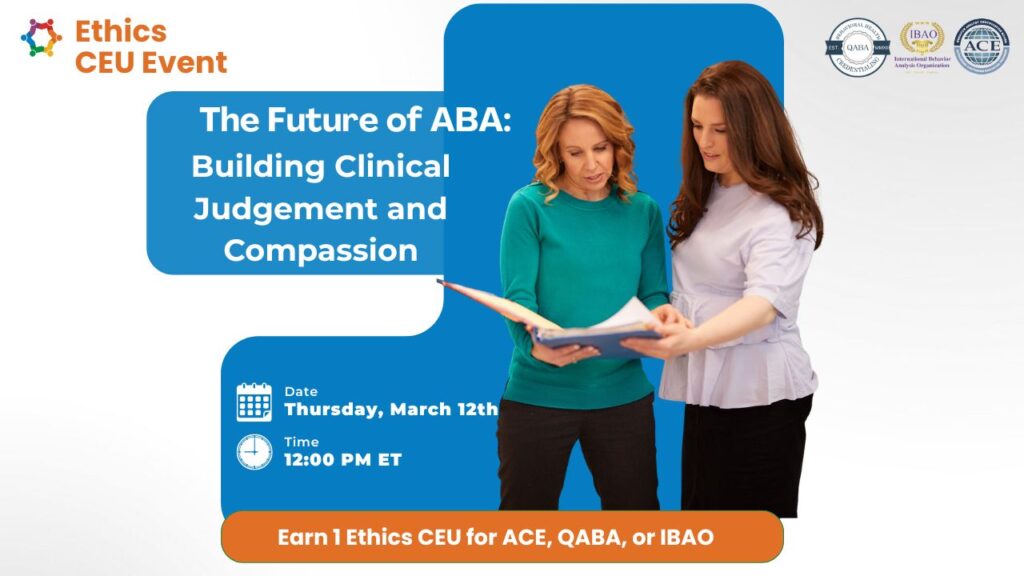
Join us for “The Future of ABA: Building Clinical Judgement and Compassion,” a live CEU event presented by Shayna Gaunt, MA, BCBA, on Thursday, March 12th, at 12 pm ET. Shayna will share her 20+ years of experience, turning complex behavior principles into practical, compassionate strategies.
Ethical Consideration #2: Accuracy Still Matters
AI can sound confident even when it’s wrong. It may:
- Misstate terminology
- Blend behavioral concepts with non-behavioral frameworks
- Offer interventions without referencing function
- Oversimplify complex skill acquisition procedures
If you’re using AI to generate teaching materials, you must verify everything.
Does the definition of differential reinforcement align with behavior analytic literature?
Is the prompting hierarchy described correctly?
Does the suggested intervention actually match the behavior function?
You are still the subject matter expert. A good rule of thumb: If you wouldn’t hand it to a parent without reviewing it line by line, don’t use it.
Ethical Consideration #3: Over-Reliance Weakens Clinical Skills
There’s another subtle risk: skill erosion. If AI writes every task analysis, every parent email, and every social script, over time, clinicians may rely less on their own critical thinking. And in ABA, our strength lies in analysis, not templates.
Use AI to reduce busywork, not to replace thinking. For example:
- Brainstorm 10 coping skill scenarios → helpful.
- Generate a full BIP without reviewing data → not appropriate.
- Draft a reinforcement menu you’ll individualize → great.
- Design programming without understanding prerequisites → problematic.
AI should save time on structure, not eliminate your clinical reasoning process. With responsible boundaries, it becomes a supportive tool rather than a replacement. Now, let’s highlight best practices.

Best Practice #1: Use AI for Drafting, Not Decision-Making
One of the healthiest ways to use AI in ABA settings is to generate materials rather than to make treatment decisions. Appropriate uses might include:
- Creating blank data sheets
- Drafting token economy visuals
- Generating example role-play scripts
- Formatting parent-friendly explanations of ABA concepts
- Brainstorming generalization ideas
Notice what’s missing from that list: diagnosis, assessment interpretation, and individualized treatment planning.
Those belong to licensed, trained professionals. Next, let’s consider best practice: always individualize AI material before use.
Best Practice #2: Always Individualize Before Implementation
AI produces generic outputs. ABA requires individualized programming. Before using any AI-generated material, ask:
- Does this match the learner’s developmental level?
- Does this align with their communication modality?
- Is the language culturally appropriate?
- Does it reflect the function of the behavior?
- Are reinforcement systems actually motivating for this learner?
If the answer to any of those questions is “not quite,” adjust accordingly. The magic of ABA isn’t in the worksheet. It’s in how precisely it matches the learner. That’s why the next best practice emphasizes team transparency.
Join us for “The Future of ABA: Building Clinical Judgement and Compassion,” a live CEU event presented by Shayna Gaunt, MA, BCBA, on Thursday, March 12th, at 12 pm ET. Shayna will share her 20+ years of experience, turning complex behavior principles into practical, compassionate strategies.
Best Practice #3: Be Transparent with Your Team
If you’re a clinic owner or clinical director, consider having a clear internal policy about AI use. Define:
- What tools are approved
- What information cannot be entered
- What review process is required
- How materials must be individualized
This does two things:
- Protects client confidentiality
- Prevents misuse by well-intentioned staff
Avoid secrecy around AI use. When tools are hidden, misuse increases. When they’re discussed openly, they’re used more responsibly. This collaborative approach is strengthened by teaching critical evaluation skills.
Best Practice #4: Teach Critical Evaluation Skills
If RBTs or newer BCBAs are using AI to help generate materials, build in supervision conversations around it. Ask:
- Why did you choose this prompt?
- What edits did you make?
- How does this align with the learner’s function?
- What would you change if progress stalls?
This turns AI into a teaching opportunity rather than a shortcut.
The Bigger Picture: AI Can Support Burnout Reduction
Let’s be honest. ABA professionals are stretched thin. Documentation demands are high, parent communication takes time, and creating individualized materials for multiple learners each week is a heavy lift.
When used ethically and thoughtfully, AI can reduce cognitive load and administrative burden. That can help clinicians:
- Focus more on direct supervision
- Spend more time analyzing data
- Preserve mental bandwidth for complex cases
The goal isn’t to replace clinicians. It’s to protect them from drowning in repetitive tasks.
ABA is grounded in ethical responsibility. That doesn’t change just because new tools emerge. AI can absolutely support the creation of teaching materials. It can spark ideas. It can accelerate formatting. It can streamline drafts.
But it should never replace clinical judgment, compromise confidentiality, or substitute for data-based decision making. At the end of the day, ethical ABA practice isn’t defined by how quickly materials are created. It’s defined by how thoughtfully they’re implemented.
Technology is evolving…our standards shouldn’t.
Ready to save time on your daily programming? Try out Intraverbal AI to streamline your workflow! Use our exclusive code howtoABA at checkout to get 10% off.