
If you’ve been in the ABA field for any length of time, you’ve probably felt it – that moment when you’re running a behavior plan by the book, and something still isn’t clicking. The data looks reasonable on paper, but the learner sitting in front of you seems more dysregulated than supported.
We’ve all been there, and it can feel incredibly discouraging. You check the data, you adjust your contingencies, and yet, you know a critical piece of the puzzle is missing.
Increasingly, behavior analysts are discovering that this missing piece is a trauma-informed lens. In a recent episode of the How to ABA podcast, hosts Shira Karpel and Shayna Gaunt had an eye-opening conversation with BCBA Dr. Camille Kolu about trauma-informed behavior analysis. The discussion highlighted a massive shift happening in our field. We’re moving away from rigid, compliance-based models and embracing compassionate care in ABA.
But what does it actually mean to be trauma-informed in a behavior-analytic setting? Let’s break down the core principles of trauma-informed ABA and look at how we can integrate these vital concepts into our daily practice to support every learner.
Trauma Is a Contextual Variable, Not a Diagnosis
When we hear the word “trauma,” it’s easy to think of it strictly as a medical diagnosis or a checkbox on an initial intake form. However, to practice trauma-informed ABA effectively, we need to shift our perspective. We must view trauma as a contextual variable that actively shapes behavior.
Just like any other learning history, a history of trauma or chronic stress operates on a learner’s behavior by conditioning their responses. It alters what functions as an aversive stimulus and what functions as a reinforcer. It essentially sets the stage for behavior in ways that might not be immediately obvious during a standard observation.
Plus, we’re not just talking about massive, isolated traumatic events. Cumulative stress – the kind of stress that builds slowly from ongoing, difficult daily experiences – causes measurable, long-term changes in the brain and the body. This matters enormously for ABA practitioners. It means our antecedent arrangements, the pacing of our sessions, and even the tone of voice we use when introducing demands can either add to a learner’s stress load or actively help buffer against it.
When we look at trauma through this behavioral lens, we stop asking, “What’s wrong with this learner?” and start asking, “What happened to this learner, and how is their environment currently maintaining this response?”
Compassionate Care Extends Beyond the Client
A truly trauma-informed approach isn’t just something we apply to the child or adult sitting across from us at the therapy table. It’s a comprehensive framework that dictates how we show up to every single professional relationship.
The parents we coach and the technicians we train all carry their own unique histories and stressors. When a parent struggles to implement a behavior plan at home, a trauma-informed practitioner does not immediately label them as “non-compliant.” Instead, we look at the environmental contingencies and the stress load that parent is carrying.
Similarly, when an RBT seems disengaged or overwhelmed, compassionate care ABA asks us to evaluate the support systems we have in place for our staff. Ultimately, we have to build environments that foster psychological safety for everyone involved in the therapeutic process.
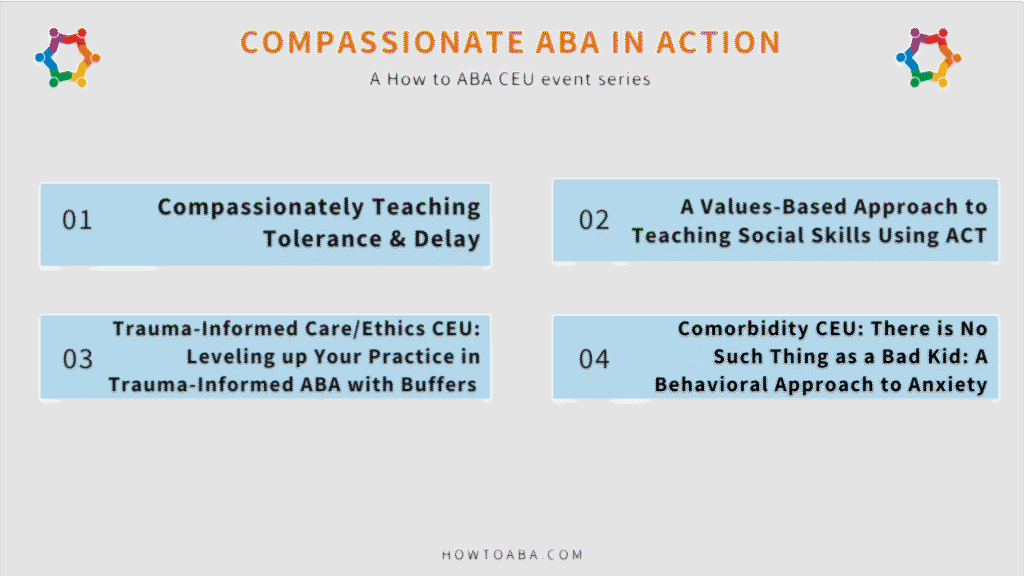
Upgrade your ABA practice with this exclusive 4-CEU bundle designed to help you implement compassionate, trauma-informed strategies while earning CEUs at an incredible value!
The Six Buffers: A Behavioral Framework for Resilience
One of the most practical ways to implement trauma-informed care is by looking at resilience through a measurable, behavioral framework. Research into Adverse Childhood Experiences (ACEs) has identified specific factors that can actually reverse the physiological changes triggered by trauma and chronic stress.
If you watched or listened to the podcast featuring Dr. Camille Kolu, you heard us dive deep into exactly what this looks like in practice. Dr. Kolu is a leading voice in trauma-informed ABA, and her recent article, Providing Buffers, Solving Barriers, beautifully outlines how we can take this research and apply it directly to our daily sessions. She explains that we can actively program specific “buffers” into our clients’ lives to protect them from the effects of toxic stress and increase their chances of thriving.
These factors are often referred to as the six buffers. As behavior analysts, we can easily operationalize these buffers and integrate them into our assessment and treatment processes.
1. Nurturing Relationships
In ABA, this translates directly to pairing and instructional control. Are we spending enough time building a genuinely reinforcing relationship with the learner before placing demands? Nurturing relationships is the foundation of all effective therapy.
2. Nutrition
Hunger and poor nutrition act as powerful motivating operations. A trauma-informed behavior plan takes into account whether a learner has access to consistent, nutritious meals and treats nutritional deficits as significant setting events.
3. Exercise
Movement is critical for emotional and physical regulation. We can program for success by embedding heavy work, gross motor play, and frequent movement breaks into our sessions to help learners regulate their nervous systems naturally.
4. Sleep
We all know that a poor night of sleep can derail a session. By actively tracking sleep patterns alongside behavioral data, we can adjust our expectations and session demands on days when a learner’s sleep buffer is depleted.
5. Mental Health Support
ABA is incredibly powerful, but it is not the only tool a learner might need. Trauma-informed BCBAs actively collaborate with occupational therapists, speech-language pathologists, and mental health counselors to ensure the learner receives holistic support.
6. Stress Relief
What does stress relief actually look like for the individual? It is not a one-size-fits-all solution. As behavior analysts, we need to identify what specific activities genuinely help our learners decompress and ensure they have free, non-contingent access to those activities.

Stress Relief Isn’t One-Size-Fits-All
When we think about stress relief, we have to look closely at the behavioral science of prediction and control. Research consistently shows that predictability and agency are two of the most powerful tools available for dampening the human stress response.
When people feel they have some control over their environment – when they can anticipate a stressor and make even small choices about how to respond – their brain and body react much more calmly.
Think about a learner who exhibits severe challenging behavior, like swiping materials off a table or eloping from a room when a new demand is placed. Through a traditional lens, we might just see demand avoidance. Through a trauma-informed lens, we recognize a learner attempting to predict and control an aversive situation.
Our job isn’t to force compliance. Our job is to build acceptable, functional repertoires for achieving that same control. We can do this by using visual schedules so the learner can predict their day, offering frequent choices (e.g., “Do you want to do the math worksheet with the blue pen or the red pen?”), and honoring self-advocacy when a learner asks for a break.
This concept applies to our staff as well. We can support our RBTs by giving them predictability in their schedules and control over how they manage their professional development. Creating systems that help our team proactively identify and problem-solve upcoming stressors prevents burnout before it starts.
We’ve Always Had the Tools
If you’re reading this and feeling a bit overwhelmed, take a deep breath. You don’t have to completely overhaul everything you know about Applied Behavior Analysis. In fact, we already have the tools required to be trauma-informed.
Functional behavior assessments, antecedent modifications, and a heavy emphasis on reinforcement and building cooperation over compliance – these are the very foundations of our science.
The shift to trauma-informed ABA training is really about applying these existing tools with greater intentionality and a much wider view of what counts as a relevant contextual variable. It means asking better, more compassionate questions during the FBA stage. It means holding the complexity of a person’s lived history alongside the ABC data we’re already so good at collecting.
Upgrade your ABA practice with this exclusive 4-CEU bundle designed to help you implement compassionate, trauma-informed strategies while earning CEUs at an incredible value!
Trauma-informed care is not a soft, unscientific addition to ABA. It is a more complete, nuanced, and effective version of what we have always been trying to do: improve the quality of life for the individuals we serve. By prioritizing compassion, building resilience through the six buffers, and providing our learners with predictability and control, we elevate our practice and set a new, beautiful standard for care in our field.