
When you think of reinforcement in ABA, things like stickers, tokens, or snacks might immediately come to mind. While those can be useful, they aren’t always the most natural – or usually the most motivating – reinforcers for children.
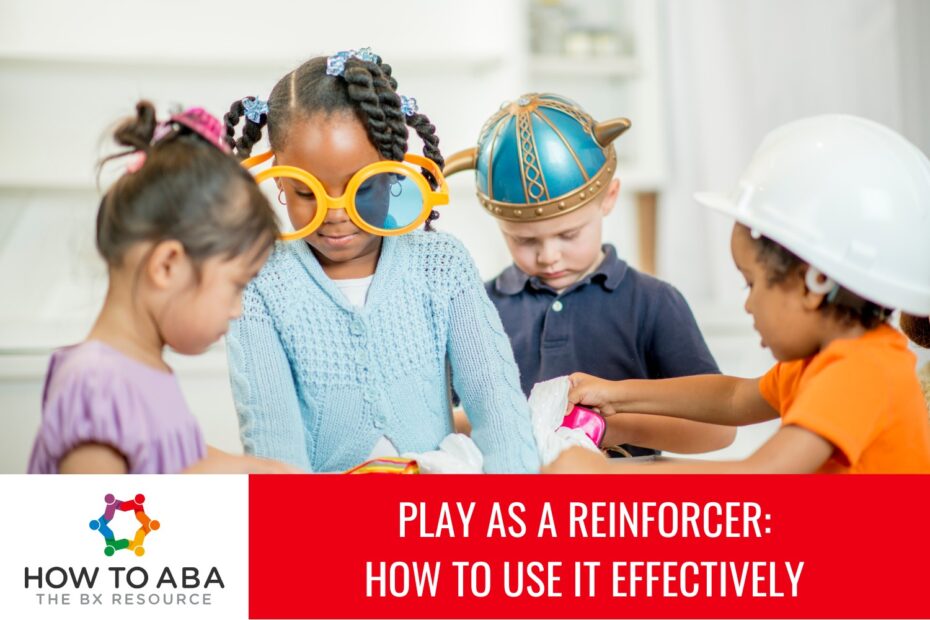
Play, on the other hand, comes naturally. It’s engaging, enjoyable, and can be seamlessly integrated into learning opportunities. Used correctly, play can be one of the most powerful reinforcers you have!
In this post, we’ll look at why play works so well as a reinforcer, how to identify the kinds of play activities that motivate each learner, and practical ways to use play effectively during sessions.
Why Play Works as a Reinforcer
Children are wired to play. It’s how they explore the world, develop social skills, and practice problem-solving. Because of this natural drive, play can often be more reinforcing than external reinforcers like candy or prizes.
Here are some of the benefits of using play as a reinforcer:
- It’s socially valid. Play feels natural in the context of learning, especially for young children, so it doesn’t seem out of place during therapy.
- It builds rapport. Engaging in play activities strengthens the relationship between the child and the therapist or parent.
- It promotes generalization. Skills practiced during play can be applied in other environments, such as the classroom, playground, or home.
It supports social skills. Play is inherently interactive and can help children practice turn-taking, sharing, and communication.
In short, play isn’t just fun; it’s a meaningful way to reinforce and teach at the same time.
How to Find the Right Type of Play
Not all children are motivated by the same activities. Some may enjoy pretend play with dolls or action figures, while others prefer building blocks, puzzles, or outdoor activities like running around. The key is to identify what’s most engaging for the individual child.
Here are a few ways to figure that out:
- Conduct a preference assessment. Offer different play materials and see which ones the child gravitates toward.
- Observe natural interactions. Pay attention to what the child chooses to do during free play.
- Ask parents and caregivers. Families can often provide insights into what activities their child enjoys most at home.
- Experiment. Sometimes, a child may need to be introduced to a new type of play before it becomes reinforcing.
Keep in mind that preferences can change over time, so it’s important to reassess periodically.
5 Strategies for Using Play Effectively
Simply allowing free play after a task isn’t always enough. To make play a truly effective reinforcer, you’ll want to use it strategically. Here are some guidelines to help:
1. Use Play Immediately After the Desired Behavior
The timing of reinforcement matters. If you promise to play “later,” the connection between the behavior and the motivation may be lost. Offering access to play immediately after a child completes a task helps strengthen the association.
2. Keep It Short and Engaging
When using play as reinforcement, keep sessions brief – just long enough to feel rewarding but not so long that it derails the flow of learning. For example, one or two minutes of blowing bubbles can be more effective than ten minutes of unstructured play.
3. Involve Yourself in the Play
Playtime is a valuable teaching moment and an opportunity to build social motivation in children. Rather than leaving learners to play alone, adults should actively join in to show that interactions with others can be as fun as playing with toys.
Participating in play – like racing cars, narrating actions, or engaging in simple games – helps reinforce social skills, strengthen relationships, and connect with children through shared joy. Ultimately, play is a chance to teach kids that being with others can be the best part of their day.
4. Pair Play With Other Learning Opportunities
Play doesn’t have to be separate from teaching. For example, you can build language goals into pretend play or use building blocks to encourage problem-solving. Reinforcement and skill development can happen at the same time.
5. Rotate Play Options
To keep things fresh, rotate different types of play activities. This prevents children from getting bored and helps maintain motivation.

Examples of Play as a Reinforcer in Action
Each of these activities is simple, motivating, and easy to integrate into a session without needing elaborate preparation.
- Bubbles: After completing a matching task, the therapist blows bubbles, and the child pops them.
- Chase: The child finishes a puzzle and earns a 30-second game of chase around the room.
- Pretend Play: A child earns time to play “kitchen” or “doctor” with the therapist after working on language skills.
- Construction: After answering questions correctly, the child gets a minute to add blocks to a tower.
- Music and Dance: Completing a writing task leads to a mini dance party with a favorite song.
4 Tips to Avoid Common Issues
Here’s how to ensure play reinforcement works for learners in your practice:
- Don’t let play turn into escape. Make sure the child understands that play is a reinforcer for completing tasks, not a way to avoid them.
- Watch for satiation. If a child has unlimited access to a toy outside of therapy, it may not work well as a reinforcer in session.
- Be clear with expectations. Let the child know what behavior earns play time. For example: “When you finish these three questions, we’ll play with the cars.”
- Fade appropriately. Over time, shift from immediate, frequent play breaks to longer intervals, building the child’s tolerance for delayed reinforcement.
Play is more than just fun; it’s an essential part of childhood. When used thoughtfully, it can be one of the most effective reinforcers in ABA. By observing what each child enjoys, introducing variety, and pairing play with skill-building, therapists and caregivers can make learning feel less like work and more like a fun experience.
Ultimately, the goal of ABA is to help children build meaningful skills that improve their daily lives. Play, with its natural appeal and social benefits, is the perfect partner in that process.