
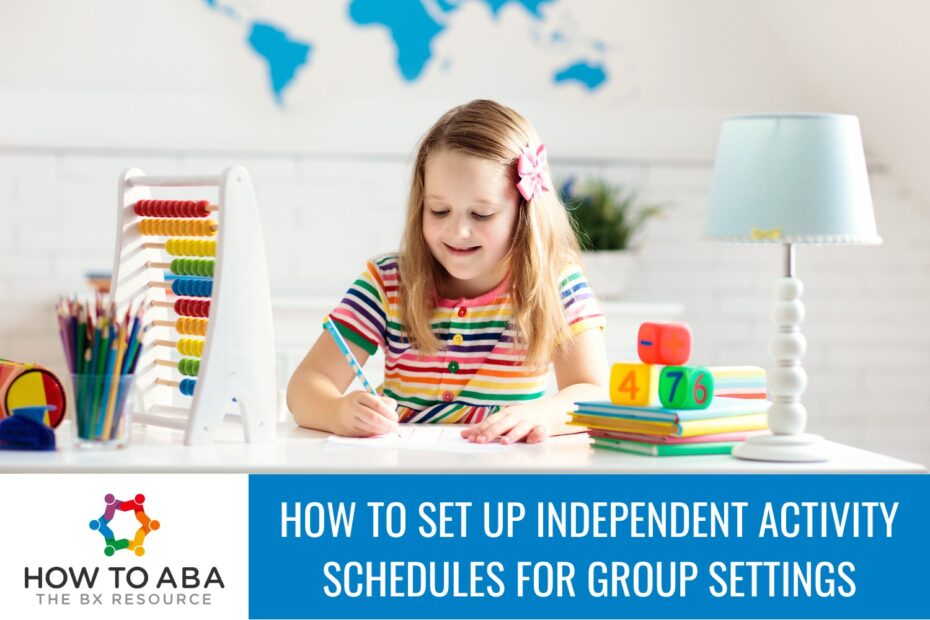
If you’ve ever tried to run a group session where learners are at completely different skill levels, you already understand the challenge. One learner finishes a task in two minutes, while another needs five more minutes. A third is waiting with nothing to do, and suddenly you’ve got a behavior problem that didn’t need to exist. Sound familiar?
Independent activity schedules (IAS) are among the most powerful tools we have for bridging that gap, but setting them up effectively in a group setting takes some intentional planning. When done right, they give learners the structure they need to work independently while freeing you or your team up to provide focused instruction where it’s needed most. Here’s how to make it work.
What is an Independent Activity Schedule?
An independent activity schedule is a set of visual or written cues that tell a learner what to do, in what order, and for how long – without an adult directing each step. The goal is independent completion, meaning the learner can navigate the schedule and its activities on their own once it’s set up.
In a group setting, IAS serves a dual purpose: it keeps learners productively engaged when they aren’t working directly with a therapist or teacher, and it builds a genuinely functional skill – the ability to manage one’s own time and tasks. That’s a skill that matters well beyond the therapy room.
What Can the Learner Already Do?
This is the most important rule when building an IAS for any setting, but it’s especially critical in a group. The activities you include should be at or just below mastery level. You’re not using IAS time to teach new skills; you’re using it to practice and reinforce what’s already solid.
Before you build the schedule, take stock of each learner’s current repertoire. Ask yourself:
- What tasks can this learner complete with minimal or no prompting?
- How long can this learner sustain attention before needing a reinforcement or break?
- Does this learner respond better to objects, pictures, or written words as cues?
Once you know this, you can build a schedule that sets learners up for success – not frustration.
Register for our CEU, Independent Activity Schedules: Building Meaningful Play and Leisure Skills, and instantly unlock your Bx Resource Pro Membership! Join our community today to access 50+ on-demand CEUs, practical resources, and expert mentorship.
Individualize Within a Group Structure
One of the biggest misconceptions about group settings is that everyone needs the same schedule. They don’t, and forcing it often backfires. What you need is a consistent routine structure that each learner’s individual schedule fits inside.
Think of it this way: at 10:00 am, all learners know it’s IAS time. They go to their designated area, pick up or open their schedule, and start working. But what each person is doing during that block is specific to them. One learner might be completing a three-step fine-motor task followed by a puzzle, while another is working through a five-item written task sequence, with a preferred activity at the end.
The shared group routine creates predictability; the individual schedules create relevance.
Set Up the Physical Space Thoughtfully
The environment does a lot of the heavy lifting here. When materials are organized and accessible, learners spend less time waiting and more time doing. A few things that make a big difference:
- Label everything clearly. Bins, folders, and workstations should have clear labels that match the learner’s schedule format. If a learner uses picture cues, their materials should be labeled with matching pictures.
- Keep materials rotation fresh. Swap out activities regularly to keep learners motivated. The schedule format stays the same even when the specific tasks change.
- Build in a “finished” component. Whether it’s a finished bin, a check mark, or flipping a card over, learners need a clear and satisfying signal that a task is complete.
- Include a reinforcer at the end. A preferred activity or access to a preferred item at the conclusion of the schedule goes a long way in maintaining motivation to complete it independently.

Teach the Schedule Before You Expect Independence
This part is skipped more often than it should be. A learner can’t use a schedule independently if they’ve never been taught how. The IAS itself is a skill that needs to be directly taught using the same principles we’d apply to anything else – prompting, fading, reinforcement.
Start with full physical guidance if needed and systematically fade your prompts as the learner becomes more fluent with the routine. In a group, you’ll often be teaching multiple learners at different points of this fading process simultaneously, which is why having clear data on prompt levels is so important. You want to know at a glance who needs a gestural prompt and who is fully independent.
Manage the Group During IAS Time
IAS time is an opportunity to provide more intensive instruction to one learner while others work independently – but only if the group is actually running smoothly. A few strategies that help:
- Do a quick sweep before pulling focus. Before you sit down with a learner for discrete-trial work, walk the room to make sure everyone is oriented and started on their schedule.
- Use proximity strategically. Position yourself so you can visually monitor the group while working with one learner. Brief, non-disruptive check-ins from a distance can catch problems early.
- Deliver intermittent reinforcement. Popping over briefly to acknowledge a learner who is working well during their IAS keeps motivation high without derailing the schedule.
Register for our CEU, Independent Activity Schedules: Building Meaningful Play and Leisure Skills, and instantly unlock your Bx Resource Pro Membership! Join our community today to access 50+ on-demand CEUs, practical resources, and expert mentorship.
Independent activity schedules aren’t just a classroom management tool; they’re a stepping stone toward genuine autonomy. When learners can direct their own attention, sequence through tasks, and complete work without constant adult direction, that’s a life skill. In a group setting, the IAS also teaches something harder to measure but equally important: the ability to exist and function alongside other people without needing to be the center of the adult’s attention.
With the right setup, regular data, and a willingness to adjust as your learners grow, IAS time can become one of the most productive parts of your day – for you and for them.