
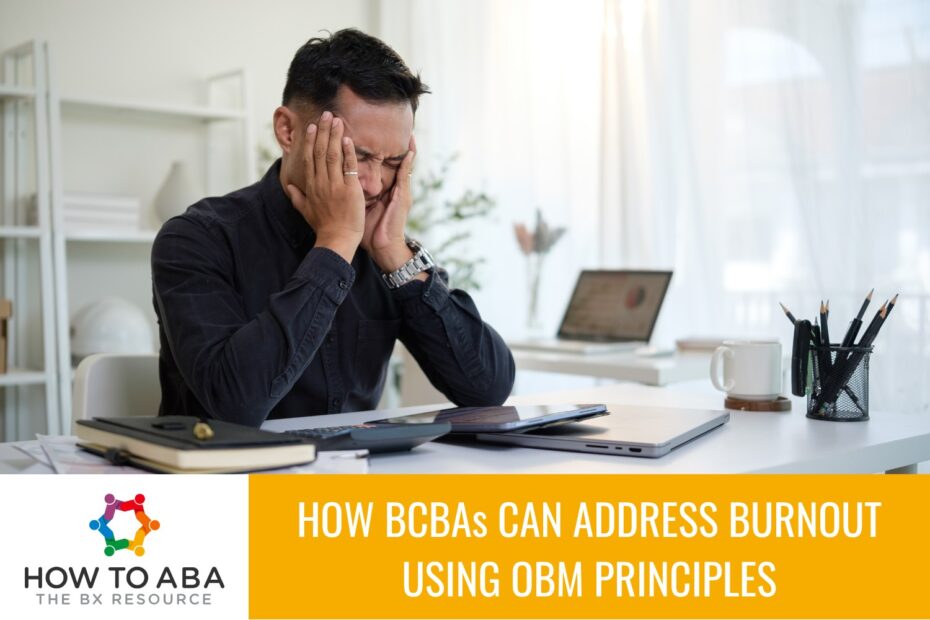
Burnout doesn’t usually show up all at once. It creeps in quietly.
It looks like dreading supervision sessions you used to enjoy. Charting that always spills into nights and weekends. Feeling irritated with systems – not clients – that never seem to improve, no matter how hard you work.
For many BCBAs, burnout isn’t about a lack of passion for the field. It’s about being stuck in environments that drain more than they give back.
The hard truth? Telling BCBAs to “practice more self-care” doesn’t fix burnout. What does help is changing the systems, contingencies, and expectations that make burnout inevitable in the first place.
OBM gives BCBAs a way to analyze burnout the same way we analyze behavior everywhere else: functionally, compassionately, and with data-driven solutions.
Burnout Is a Systems Problem, Not a Personal Failure
Many BCBAs internalize burnout as a personal shortcoming. They may think, “I should be able to handle this. Other people manage; why can’t I?”
OBM shifts our focus upstream. Burnout is often a predictable result of poor organizational systems: high effort, unclear expectations, inconsistent reinforcement, role overload, and lack of feedback.
From an OBM perspective, burnout isn’t a flaw in the BCBA. It’s a signal that the environment is not supporting sustainable performance. Once you shift that lens, the conversation changes from “How do I cope better?” to “What needs to change in the system?”
Use a Functional Assessment Lens on Your Work Environment
BCBAs are experts at functional assessment with clients – but we rarely turn that skill inward. Start by asking:
- What tasks consistently drain me the most?
- Where am I spending the most effort for the least reinforcement?
- What behaviors am I engaging in that signal burnout (avoidance, procrastination, emotional exhaustion)?
From an OBM standpoint, burnout-related behaviors often function to escape or avoid aversive work conditions. Long documentation requirements, excessive caseloads, unclear performance metrics, and lack of autonomy are common antecedents.
Mapping these patterns shows where to intervene: in task design, workload, feedback, or leadership; not just personal resilience.

Redesign the Work, Not Just the Schedule
One of the biggest misconceptions about burnout is that time off alone will fix it. While rest matters, OBM emphasizes work design just as much as work hours.
Consider:
- Are expectations clearly defined, or are you constantly guessing what “good enough” looks like?
- Is your workload measured realistically, or based on outdated assumptions?
- Are tasks aligned with your actual role, or are you filling systemic gaps?
OBM encourages job redesign to reduce unnecessary response effort and increase access to reinforcement. This might look like streamlining documentation systems, clarifying supervision expectations, or redistributing administrative tasks that pull BCBAs away from meaningful clinical work.
When the work itself becomes more efficient and purposeful, burnout naturally decreases.
Increase Meaningful Reinforcement (Not Just Praise)
Many organizations rely heavily on delayed or vague reinforcement – annual reviews, generic praise, or “thank you for all you do” emails. OBM reminds us that reinforcement must be timely, specific, and valuable to actually maintain behavior. For BCBAs, meaningful reinforcement often includes:
- Autonomy in decision-making
- Opportunities for professional growth
- Clear performance feedback
- Recognition tied to specific contributions
- Work-life boundaries that are actually respected
If reinforcement is rare, inconsistent, or disconnected from effort, burnout becomes more likely. OBM-informed leaders work to build systems that allow BCBAs to contact reinforcement regularly, not just during crisis moments or staff shortages.

Address Role Clarity & Scope Creep
Burnout often intensifies when roles slowly expand without adjustment. Many BCBAs find themselves acting as clinicians, supervisors, trainers, administrators, problem-solvers, and emotional supports – often simultaneously.
OBM emphasizes role clarity as a protective factor. When responsibilities are clearly defined and aligned with reinforcement, performance improves, and stress decreases. Ask:
- What responsibilities have been added over time without formal acknowledgment?
- Which tasks fall outside my scope but remain my responsibility?
- Where are boundaries unclear or inconsistently enforced?
Clarifying roles and advocating for systems that respect them are crucial to sustainability.
Use Data to Advocate for Change
BCBAs are uniquely positioned to advocate for themselves using the language organizations understand: data. OBM encourages tracking indicators such as:
- Caseload size versus billable and non-billable hours
- Turnover rates and staff absenteeism
- Time spent on administrative versus clinical tasks
- Delays in feedback or decision-making
Presenting burnout as an organizational performance issue – not an emotional complaint – shifts conversations with leadership. It reframes burnout as an issue that affects quality, retention, and outcomes, not just morale. Data-driven advocacy is often more effective than burnout conversations rooted only in feelings (even though those feelings are valid).
Burnout isn’t fixed with better self-care; it’s addressed by redesigning the systems that shape your work. If this resonates, our membership gives you practical tools, CEUs, programs, resources, and community to help you build sustainable performance instead of just surviving the week.
When OBM Support Makes the Biggest Difference
While individual BCBAs can apply OBM principles on their own, burnout often requires system-level intervention. This is where OBM practitioners and consultants can play a critical role. OBM professionals help organizations identify environmental contributors to burnout, redesign workflows and expectations, and improve feedback and reinforcement systems. They also train leaders to support sustainable performance and align organizational goals with staff well-being.
For BCBAs feeling stuck, OBM support can provide both language and leverage to create meaningful change – without placing the burden solely on the individual.
Burnout doesn’t mean you don’t care enough. It means you’ve been caring for inside systems that weren’t built to support you.
OBM offers BCBAs a powerful reminder: behavior makes sense in context. When the context changes, behavior can too. Addressing burnout isn’t about pushing harder – it’s about designing environments where skilled, compassionate professionals can actually thrive.
If you’re feeling burned out, it may not be time to leave the field. It may be time to change the system.