
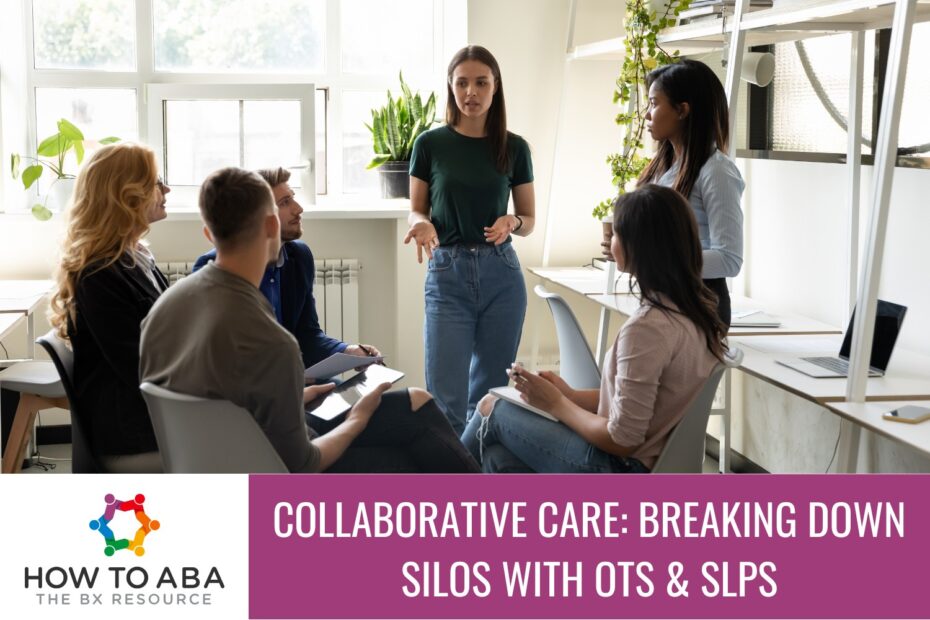
If you’ve ever sat in a team meeting where everyone is talking about the same child, but somehow describing completely different kids, you know exactly what siloed care looks like in practice. The OT is focused on sensory processing and fine motor skills. The SLP is zeroed in on language and feeding. And the BCBA is tracking behavior function and skill acquisition. Three professionals, one child, and sometimes very little overlap in how they’re talking to each other.
This doesn’t have to be the norm. In fact, when BCBAs, occupational therapists, and speech-language pathologists genuinely collaborate – not just co-exist on a team roster – the outcomes for learners improve in ways that no single discipline can create alone.
Why Do Silos Happen in the First Place?
It’s rarely intentional. Schedules don’t line up, notes get buried in separate systems, and everyone is stretched thin. Add in the fact that each discipline has its own framework, jargon, and way of conceptualizing behavior, and it’s easy to see how providers end up working in parallel rather than together.
There’s also a professional territory piece that’s honestly worth naming. Sometimes, disciplines can be protective of their scope in ways that inadvertently limit communication. A BCBA might hesitate to ask questions about sensory strategies because it feels outside their lane. An OT might not loop in the behavior team because they assume the challenging behavior is purely sensory-driven. In the end, neither assumption serves the learner.
Join Shira Karpel for our live CEU, Managing the Mayhem: Supporting Busy Classrooms and Group Settings, and instantly unlock your Bx Resource Pro Membership!
What Each Discipline Brings to the Table
Understanding what OTs and SLPs actually do – beyond a surface-level awareness – makes collaboration much more practical.
Occupational therapists are looking at how a child engages with their daily environment. They assess sensory processing and regulation, fine and gross motor development, and how these factors affect participation in meaningful activities. When a child is struggling to sit through a teaching session or having a meltdown during transitions, an OT’s lens can reveal contributing factors that behavior-function alone doesn’t explain.
Speech-language pathologists do far more than teach kids to talk. They’re addressing how a child understands and expresses language, how they process auditory information, how they eat and drink safely, and increasingly, how they use AAC to communicate. When a BCBA is working on manding or building a communication system, the SLP’s expertise on language development and vocabulary selection is invaluable.
For BCBAs, the value we bring to the team is a systematic, data-driven approach to understanding why behavior is happening and how to teach new skills effectively. That framework can actually strengthen the work of every other provider on the team…but only if we’re talking to each other.

How to Make Collaboration Practical
Joint goal-setting is one of the most powerful places to start. Instead of each provider writing goals in isolation and hoping they don’t conflict, bring everyone to the table early. Look for goals that overlap – communication goals that could be reinforced during ABA sessions, sensory strategies from OT that could reduce problem behavior before it starts, and fine motor targets that can be embedded into existing ABA programs.
Shared data matters too. If an SLP is seeing a child twice a week and tracking communication in their sessions, that information is relevant to what you’re doing with your programs. Ask for it, then share yours in return. You don’t need identical data systems, but you do need to be looking at the same child’s progress together.
What’s more, regular communication doesn’t have to mean lengthy meetings. A 10-minute check-in, a shared notes document, or even a quick message to say “we tried X this week and here’s what happened” can do more for team cohesion than a monthly meeting where everyone reads from their reports.
One specific strategy worth trying: designate a shared priority for each learner – a skill or behavior challenge that all providers agree is the most important thing to target right now. When the whole team is pulling in the same direction, even briefly, the momentum it creates is noticeable.
Join Shira Karpel for our live CEU, Managing the Mayhem: Supporting Busy Classrooms and Group Settings, and instantly unlock your Bx Resource Pro Membership!
When Collaboration Gets Complicated
Different providers sometimes have conflicting ideas about what a behavior means or how it should be addressed. An OT might interpret a behavior as sensory seeking; a BCBA might identify it as attention-maintained. Both can be true. The goal isn’t to decide who’s right; it’s to figure out what the child needs and create a plan that addresses multiple variables at once.
When disagreements come up, ground the conversation in the data. What are we seeing? What does the child’s response tell us? What have we tried, and what happened? This keeps the focus where it belongs: on the learner.
Collaborative care is one of those things that sounds good in theory, but requires real effort to build in practice. It means slowing down enough to communicate, being genuinely curious about what other providers know, and accepting that none of us has the complete picture alone.
The families we work with are counting on their child’s team to function like a team. When BCBAs, OTs, and SLPs work together – really work together – the result is care that’s more cohesive, more responsive, and ultimately more effective. That’s worth the extra effort it takes to break down those silos.