
One of the most important parts of our work as ABA professionals is choosing the right assessment tool. Assessments guide our understanding of where to begin, how to individualize supports, and which goals will be most meaningful for the person we’re working with.
But here’s the challenge: no two learners are the same. A three-year-old entering an early learning program and a fifteen-year-old navigating high school have very different needs, interests, and developmental milestones. The tool we use for one may not be the best fit for the other.
When we take the time to tailor assessments to the individual – considering age, environment, and family priorities – we gain more accurate insights and create goals that actually matter in everyday life. Let’s look at how to select and adapt assessment tools across different age groups.
The Big Picture: Why the Right Tool Matters
Assessments are more than checklists. They’re an opportunity to build relationships, discover strengths, and learn about what motivates a learner.
Using the wrong tool can lead to goals that don’t resonate with the individual or their family. Using the right tool ensures that the work we do is relevant, respectful, and aligned with real-life outcomes.
The goal isn’t to “change” someone – it’s to support them in gaining skills that make life more meaningful and independent. That starts with how we assess.
Ready to take the guesswork out of assessments and programming?
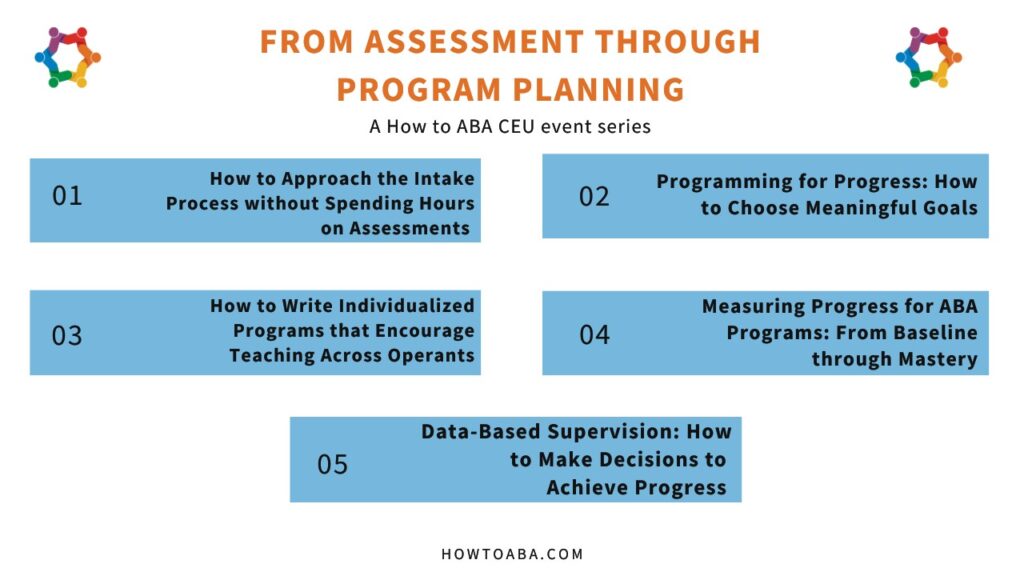
That’s exactly why we created the Assessment through Program Planning Bundle – a 5-part CEU series designed to help you bridge the gap between raw data and meaningful, individualized treatment plans.
For Toddlers & Preschoolers
Young learners are often in the early stages of communication, play, and social interaction. Assessments at this stage should be playful, flexible, and designed to capture the foundational skills that prepare children for lifelong learning.
Commonly Used Tools
- VB-MAPP (Verbal Behavior Milestones Assessment and Placement Program): Especially useful for identifying communication, play, and early learning skills. It also highlights barriers to learning and gives us direction for teaching.
- ESDM (Early Start Denver Model): A play-based, relationship-focused approach designed for young children with autism. It integrates ABA principles to promote communication, social skills, and cognitive development in naturalistic settings.
Key Considerations
- Incorporate parent support: Families can provide valuable context about how their child communicates, what motivates them, and which routines are most important.
- Observe play in natural settings: A toddler’s “test performance” may look different than their true abilities on the playground or at home.
- Keep it short and engaging: Young children thrive in short bursts of learning, so chunk assessments into manageable pieces.
The priority here isn’t filling in every box but gaining a snapshot of skills in a way that feels fun and respectful for the child.
For Elementary-Aged Learners
As children enter school, assessments need to capture not only academic readiness but also social, communication, and daily living skills that support participation in the classroom and community.
Commonly Used Tools
- ABLLS (Assessment of Basic Language and Learning Skills): A comprehensive tool for early communication, self-help, and play skills.
- Adaptive Behavior Scales: Often used to measure adaptive behavior in real-world contexts.
- School-Based Assessments: PEAK is a great assessment for school-age learners, offering both an assessment and a curriculum component.Additionally, the Inventory of Good Learner Repertoires (IGLR) is an excellent tool for evaluating school-age skills, focusing on classroom behavior, peer relationships, and academic foundations.
Key Considerations
- Look beyond academics: Skills like following group routines, asking for help, and navigating the playground are just as important as reading or math readiness.
- Include the learner’s choice: Even at this age, children can make choices and share preferences. Let them help guide what they’d like to work on.
- Respect individuality: Some children may be non-speaking or prefer alternate communication systems. Assessments should capture all modes of communication, not just spoken words.
Here, the right assessment tool helps us see how children can succeed both inside and outside the classroom.

For Middle School Learners
The middle school years are full of change. Learners are seeking independence, managing new social expectations, and developing stronger identities. Assessments at this stage should reflect those realities.
Commonly Used Tools
- Social Skills Assessments: Tools that evaluate perspective-taking, problem-solving, and peer interactions.
- EFL (Essentials for Living): A practical tool for assessing and teaching functional skills, focusing on communication, behavior, and daily living skills for individuals with moderate to severe disabilities.
- Individualized Checklists: Sometimes, tailoring a smaller, custom checklist focused on the learner’s unique goals is more effective than a standardized tool.
Key Considerations
- Prioritize functional life skills: Skills like ordering at a restaurant, using public transportation, or organizing materials for school have a lasting impact.
- Support self-advocacy: Assessments should ask, directly or indirectly, how learners express preferences and advocate for themselves.
- Incorporate assent: Always explain what you’re doing, ask if the learner is ready, and respect when they say “not right now.”
Middle school assessments should set the stage for increased independence and dignity as learners step into new roles.
For Teens & Young Adults
By the teen years, the focus often shifts to preparing for adulthood. Assessments should highlight vocational skills, independent living, and social relationships that extend beyond school.
Commonly Used Tools
- Transition Assessments: Tools that measure readiness for employment, community involvement, and independent living.
- AFLS Vocational and Independent Living Modules: Especially valuable for identifying next steps toward independence.
- Interest Inventories: These give teens a chance to voice what they enjoy and what kind of future they envision.
Key Considerations
- Look to the future: What does the learner want for themselves after high school? Assessments should point toward those long-term goals.
- Respect autonomy: Teens deserve to be part of the process. Invite them to reflect on what’s working, what’s hard, and what matters most to them.
- Balance skill-building with acceptance: It’s not about “fixing” who they are — it’s about equipping them with tools that help them thrive.
For teens, the right assessment tool is the one that honors their voice and prepares them for meaningful adult roles.
Ready to take the guesswork out of assessments and programming?
That’s exactly why we created the Assessment through Program Planning Bundle – a 5-part CEU series designed to help you bridge the gap between raw data and meaningful, individualized treatment plans.
 Bringing It All Together
No matter the age, the best assessment tools are those that:
- Highlight strengths as much as areas of growth
- Involve families and caregivers in the process
- Emphasize motivation, choice, and dignity
- Translate into goals that make a real difference in daily life
When we move beyond one-size-fits-all checklists and tailor our assessments to the individual, we’re not just gathering data – we’re creating a roadmap that respects who they are today and supports who they want to become.
Choosing the right assessment tool isn’t about following a script. It’s about matching the tool to the person, not the other way around. From toddlers to teens, when we keep assessments person-centered and collaborative, we set the stage for growth that truly matters.