
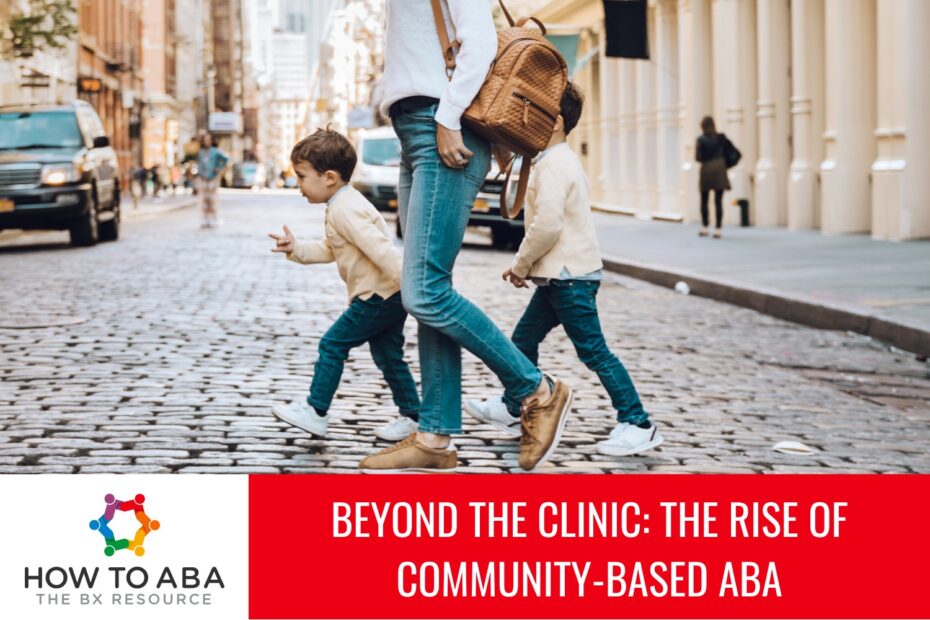
If you’ve been in the ABA field for any length of time, you’ve definitely had this thought: “They can do this here, but will it actually carry over?” It’s one of the most honest tensions we face as BCBAs. We spend hours carefully building skills in structured settings, with familiar people and predictable routines. Then, we hold our breath and hope it all transfers to the grocery store, the school hallway, or the playground.
This is where the shift toward community-based ABA comes in, and it’s responding directly to that long-standing tension. While the approach itself isn’t new, it’s gaining serious momentum – and for very good reason. It’s about bridging the gap between the clinic and real life.
What Does Community-Based ABA Actually Look Like?
Community-based ABA is all about taking learning out of the clinic and into the environments where learners actually live their lives. (It’s ABA in the wild!) This might look like working on communication skills at a local coffee shop, practicing the steps of grocery shopping in a real store, navigating public transit, or building peer interactions during a recreational program.
Here, the setting is the entire point. Practicing skills in real-life contexts directly builds generalization from the very beginning. It makes learning more meaningful and durable by design, connecting the skills we teach to the world where they will be used.
Want to go deeper into what ethical, compassionate ABA really looks like in practice? Get the recording of our latest Ethics CEU: “The Future of ABA: Building Clinical Judgment and Compassion.”
Why is the Shift Happening Now?
The momentum behind community-based ABA isn’t random. It’s a response to important conversations happening both inside and outside our field.
1. Families Are Asking For It
Parents and caregivers are more informed and vocal than ever before. They are rightly focused on what quality of life looks like for their child, not just what progress looks like on a data sheet. They’re asking the tough questions: Is my child learning to navigate the world, or just a therapy-room version of it?
2. Supporting Neurodiversity
The neurodiversity movement has pushed our field to reflect seriously on the ultimate goals of our work. The objective isn’t to make individuals with autism look a certain way; it’s to support them in living full, connected, and self-determined lives.
Community-based ABA, when done well, is rooted in this exact value. The skills we target are the ones that open doors in the world – ordering food independently, asking for help in a store, engaging in community activities, and eventually, getting and keeping a job.
3. Behavior is Dependent on Community
Finally, there’s a growing recognition that the clinic, as useful as it is, has real limitations. We know that behavior is context-dependent. The stimuli, social dynamics, and sensory environment all change the moment you walk outside.
Community settings give us access to the real antecedents and natural consequences that drive behavior. That’s incredibly valuable data that we simply can’t replicate in a controlled setting.

Consent, Choice & Doing It Right
Taking ABA into the community comes with responsibilities that are easy to overlook when you’re just focused on logistics. Consent and assent matter enormously here. The individual needs to have a say in where they go, what they work on, and how support is provided – not just in theory, but in actual practice. Community settings can feel exposed and unpredictable, which can be a significant source of stress for many learners.
Building choice into these sessions isn’t just ethically sound; it’s also just good behavior science. When learners have genuine agency over their learning, motivation naturally follows. They’re more likely to engage, persist through challenges, and actually want to return the following week. Instructional motivation is real, and it thrives when what we’re teaching truly matters to the person learning it.
It’s crucial to respect the individual’s dignity by being mindful of how support looks in different settings. We must adapt our prompting, our responses to mistakes, and our general visibility so the person feels understood and respected. Prioritizing less intrusive supports whenever possible is key.
Want to go deeper into what ethical, compassionate ABA really looks like in practice? Get the recording of our latest Ethics CEU: “The Future of ABA: Building Clinical Judgment and Compassion.”
What BCBAs Need to Think About
Community-based work requires a different kind of clinical flexibility. You can’t always control the environment. A crowded bus, an unexpected change in a store’s layout, or a stranger who asks a confusing question – these aren’t problems to eliminate. They’re the whole point. The real skill is in how you prepare for them, how you support the individual through them, and how you use them as learning opportunities without making the experience aversive.
Parent coaching is also central to this model. Families are in the community constantly – at the park, the library, birthday parties, and family gatherings. When BCBAs can work alongside families in these settings, even periodically, it builds their capacity in a way that a weekly clinic session simply cannot. The ultimate goal is for the family to feel equipped and confident, not dependent on us.
Of course, planning for documentation, supervision, and safety is essential before any community session begins. The complexity is part of the benefit, but only if it’s handled well.
Community-based ABA isn’t a replacement for structured learning – it’s an expansion of it. Both have a role, and the most effective programming thinks carefully about how to connect them. Skills built in the clinic should be finding their way into real life, and real life should be informing what we build in the clinic.
When we zoom out and look at the full picture – not just the program binder, but the whole person navigating their whole life – community-based ABA starts to feel less like an add-on and more like an essential part of what we do. The clinic is where we teach. The community is where it counts.