
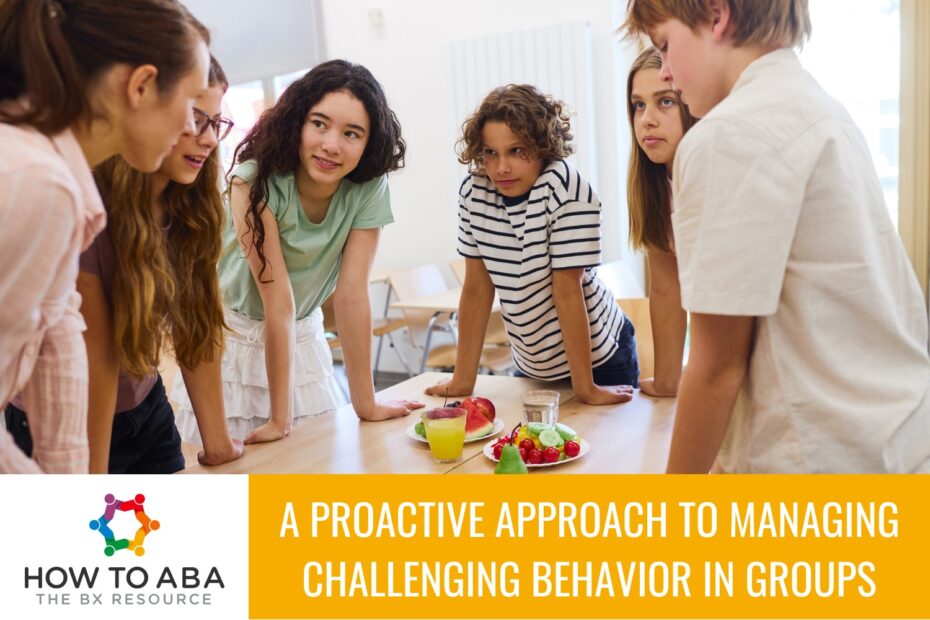
If you’ve ever run a group session and thought, “Why does everything fall apart the moment I add more than two kids to this room?” – you’re in very good company.
Group settings are among the most rewarding parts of ABA practice, and also among the most humbling. The dynamics shift constantly, the antecedents multiply, and the behavior you thought you had a handle on in a 1:1 session suddenly looks completely different when four other kids are in the mix.
Here’s the thing, though: most of the challenging behavior we see in group settings is predictable. And if it’s predictable, it’s preventable – or at least manageable – with the right proactive strategies in place before anyone walks through the door.
Start With the Environment, Not the Behavior
When challenging behavior shows up in a group, our instinct is to zero in on the child who’s struggling. But in a group setting, the environment itself is often the real culprit.
Before your first session, walk through the space with fresh eyes and ask yourself: Is there enough room for everyone to move without bumping into each other? Are the materials clearly organized and accessible? Are there obvious escape routes permitted if someone gets overwhelmed?
Crowded spaces, limited materials, and unclear boundaries are antecedents for all kinds of behavior – grabbing, aggression, elopement, you name it. Intentionally arranging the physical environment is one of the highest-leverage moves you can make, and it costs nothing except a little planning time.
Think about seating arrangements, too. Some learners do better facing away from visual distractions. Others need to be close to an adult for predictability and reassurance. Knowing your learners and arranging accordingly is the best antecedent intervention.
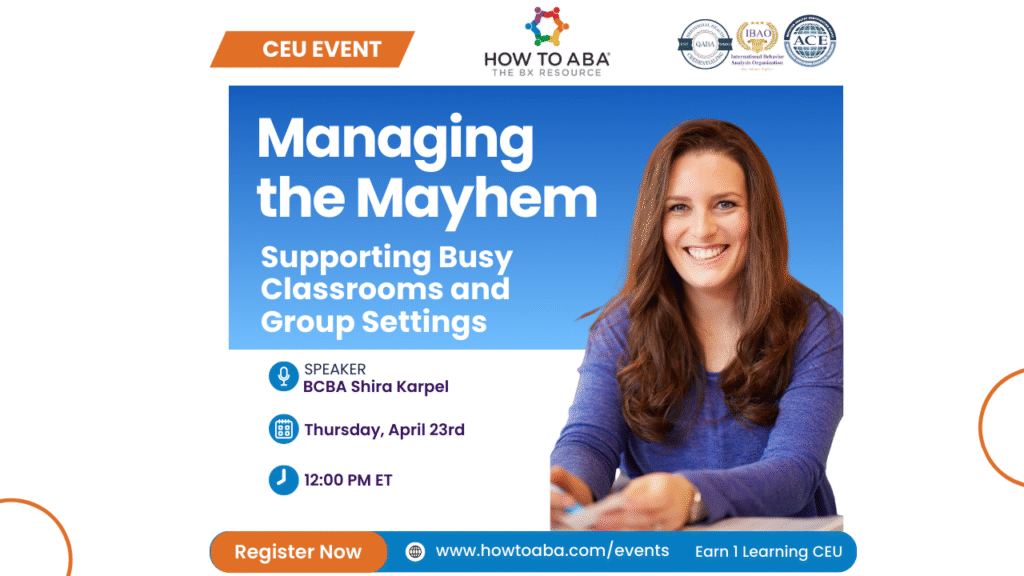
Join Shira Karpel for our live CEU, Managing the Mayhem: Supporting Busy Classrooms and Group Settings, to gain practical strategies that help your students thrive. Your registration instantly unlocks a Bx Resource Pro Membership, giving you immediate access to over 50 on-demand CEUs, everyday classroom resources, and our supportive mentorship community!
Establish Predictability Before You Need It
Challenging behavior in groups often spikes during transitions, unstructured moments, or any time expectations are fuzzy. The antidote is predictability – and you have to build it before behavior becomes the issue, not after.
Visual schedules are essential here, not optional. When every learner in the group can see what’s happening now, what’s coming next, and when the session ends, you’ve eliminated a huge source of uncertainty. For some learners, uncertainty is the primary trigger for problem behavior. Removing it proactively is simply good behavior science.
Group rules and routines serve the same purpose. Keep them short, stated positively, and taught explicitly – don’t assume learners know what “good listening” looks like. Show them. Practice the routine when things are calm, not when you’re already managing a crisis.
The more fluent the group is with your daily structure, the less bandwidth behavior management takes up, and the more energy you have for actual teaching.
Build a Group Reinforcement System That Actually Works
One of the biggest mistakes in group ABA is relying too heavily on individual reinforcement while ignoring the group dynamic entirely. What happens to one learner affects every learner in the room – for better or worse.
A group contingency can be a game-changer. When the whole group earns reinforcement together through collective behavior, you naturally harness positive peer pressure and create shared motivation. Done well, learners start encouraging each other rather than competing or reacting to one another’s behavior. It’s worth the setup.
That said, group contingencies need to be designed carefully. If one learner is consistently preventing the group from earning the reward, you’re setting up resentment – which can make behavior worse, not better. In those cases, an independent group contingency (where each person earns based on their own behavior) may be the better fit. Know your group, and build the system around the actual people in the room.

Know Your Learners Before They Walk In
This one sounds obvious, but it’s easy to skip when you’re busy. Group sessions require a higher level of proactive planning than 1:1 sessions because the interactions are more complex and the margin for error is smaller.
Before your group meets, review each learner’s behavior plan. Know the early warning signs. Know what each person finds reinforcing and what they find aversive. Know who tends to escalate when overstimulated and who shuts down when ignored. This isn’t just background information – it’s active clinical knowledge that should shape your seating, pacing, prompting hierarchy, and staff positioning in the room.
If you have RBTs or support staff running the session with you, this is exactly the kind of information they need before the group starts — not whispered mid-session while one child is already escalating. A quick pre-session huddle can make an enormous difference.
When Behavior Still Happens (and It Will)
Even the best proactive systems aren’t bulletproof. Challenging behavior will still happen, and how the group responds matters as much as how the individual is supported. The goal is to address the challenging behavior in a calm, dignified way that doesn’t turn into a spectacle that disrupts or entertains the rest of the group.
A few things that help: have a clear, pre-planned response protocol so staff aren’t making reactive decisions under pressure. Keep your voice neutral and your instructions minimal – more words rarely help. And whenever possible, redirect attention back to the group activity so the other learners don’t lose momentum while you manage the situation.
After the session, debrief. What triggered the behavior? Was there an antecedent you can address next time? Did the environment need adjusting? Data collection in group settings is incredibly helpful – use it.
Join Shira Karpel for our live CEU, Managing the Mayhem: Supporting Busy Classrooms and Group Settings, to gain practical strategies that help your students thrive. Your registration instantly unlocks a Bx Resource Pro Membership, giving you immediate access to over 50 on-demand CEUs, everyday classroom resources, and our supportive mentorship community!
Managing challenging behavior in groups isn’t about reacting faster. It’s about setting up conditions where behavior problems are less likely to occur in the first place. When your environment is thoughtfully arranged, your routines are solid, your reinforcement systems are in place, and you know your learners well, the group practically runs itself – or at least, it runs a whole lot more smoothly. And on the days it doesn’t? That’s what the debrief is for.