
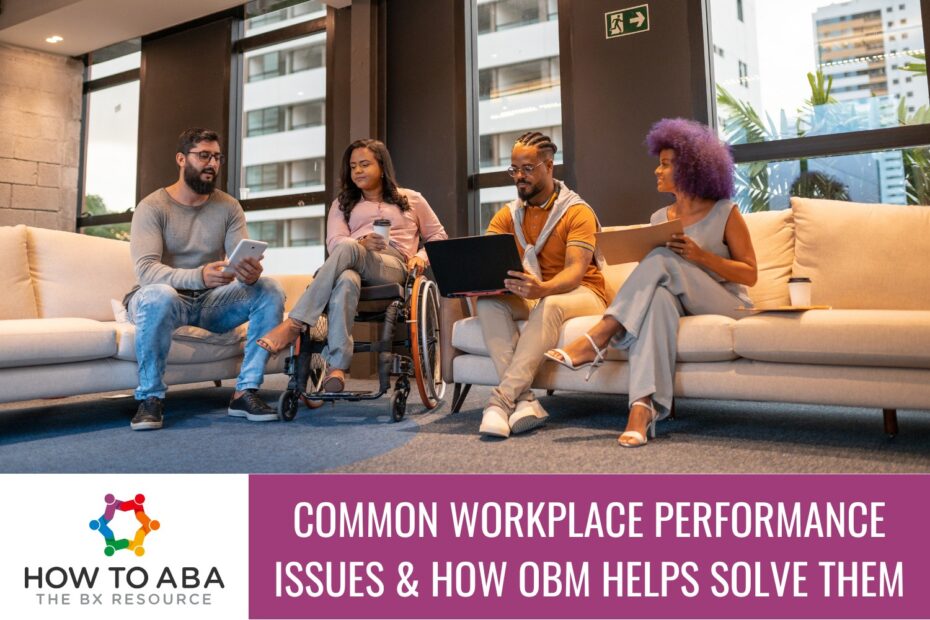
If you’ve ever found yourself thinking, “My team knows what to do… so why isn’t it happening?” you’re not alone.
Supervisors, clinical directors, and business owners across ABA organizations face performance challenges every day. Missed deadlines. Inconsistent follow-through. Staff who seem motivated one week and disengaged the next. And often, the default response is more training, more reminders, or more policies. But here’s the hard truth: most workplace performance problems aren’t motivation problems or “people problems.” They’re system problems. That’s where Organizational Behavior Management (OBM) comes in. OBM applies the science of behavior analysis to workplace performance, helping organizations create environments where the right behaviors happen more often – and for the right reasons.
Let’s break down five of the most common workplace performance issues and how OBM offers practical, sustainable solutions.
Why OBM Works, Especially in ABA Organizations
ABA professionals already understand behavior. OBM simply applies that same science to staff performance, leadership, and systems. When organizations use OBM:
- Expectations are clearer
- Feedback is more effective
- Training sticks
- Motivation is intentional
- Leadership becomes less stressful
Performance improves not because people are pushed harder, but because the environment is designed better.
1. Expectations Are Unclear (or Assumed)
One of the most common performance issues sounds simple, but causes endless frustration: employees aren’t actually clear on what’s expected of them. Leaders often say things like:
- “They should know how to do this by now.”
- “We covered this in training.”
- “It’s common sense.”
From an OBM perspective, “should know” isn’t a strategy.
How OBM Helps
OBM emphasizes pinpointing behavior, clearly defining what success looks like in observable, measurable terms. Instead of vague expectations like “be more professional” or “manage time better,” OBM asks:
- What specific behaviors should be happening?
- When should they happen?
- What does success look like?
Clear job expectations, task checklists, performance standards, and visual supports all reduce ambiguity. When expectations are explicit, performance improves – not because people suddenly care more, but because they finally know exactly what to do.
2. Feedback Is Inconsistent or Ineffective
Many organizations rely on annual reviews or only give feedback when something goes wrong. The result? Employees feel blindsided, defensive, or unsure how they’re actually doing. Feedback that is:
- Too infrequent
- Overly critical
- Vague (“Good job” or “Do better”)
…does very little to change behavior.
How OBM Helps
OBM treats feedback as a skill, not a personality trait. Effective feedback in OBM is:
- Timely – given close to the behavior
- Specific – tied to observable actions
- Balanced – recognizing what’s working, not just what isn’t
OBM systems often include regular performance check-ins, data-based feedback, and supervisor coaching models. When feedback becomes predictable and constructive, staff are more receptive – and performance improves without constant micromanaging.
3. Training Doesn’t Transfer to the Job
Sound familiar? You invest time and money in training, everyone nods along…and then nothing changes. This happens because training alone doesn’t ensure performance.
How OBM Helps
OBM looks beyond training and focuses on performance supports in the natural work environment. That includes:
- Practice with real tasks
- On-the-job coaching
- Clear performance cues
- Follow-up feedback
OBM asks an important question: What happens after training that either supports or competes with the new behavior? By aligning training with real-world contingencies, OBM ensures skills don’t just stay in a training room; they show up where they matter most.

4. Motivation Is Low (or Short-Lived)
Leaders often assume motivation is something employees either have or don’t have. OBM takes a very different view. Consequences influence motivation what happens after a behavior occurs. If high performance leads to:
- No acknowledgment
- More work
- Little reinforcement
…then performance will naturally decline.
How OBM Helps
OBM helps organizations design reinforcement systems that actually work. This doesn’t mean pizza parties or generic incentives. It means identifying what truly functions as reinforcement for your staff and connecting it to meaningful performance behaviors.
Recognition programs, growth opportunities, performance-based incentives, and social reinforcement – when used intentionally – can dramatically increase engagement and consistency.
The key OBM insight? People do more of what works for them.
5. Leaders Spend Too Much Time “Putting Out Fires”
When systems are unclear, leaders end up reacting instead of leading. Every day becomes a cycle of reminders, corrections, and crisis management. This is exhausting and unsustainable.
How OBM Helps
OBM shifts organizations from reactive management to proactive systems, by:
- Tracking performance data
- Identifying patterns
- Adjusting environmental variables
…leaders can prevent issues before they escalate.
Instead of asking, “Why is this person not doing their job?” OBM asks, “What in the system is making this behavior difficult to sustain?”
The result? Leaders spend less time correcting and more time coaching, planning, and growing their organization.
If your workplace performance challenges feel persistent, frustrating, or confusing, it’s likely not a “people problem.” It’s a systems problem, and systems can be changed.
OBM provides a practical, compassionate, and data-driven approach to support staff success while reducing leaders’ burnout. And when performance systems work, everyone benefits – from employees to clients to the organization as a whole.